By Judie Brown
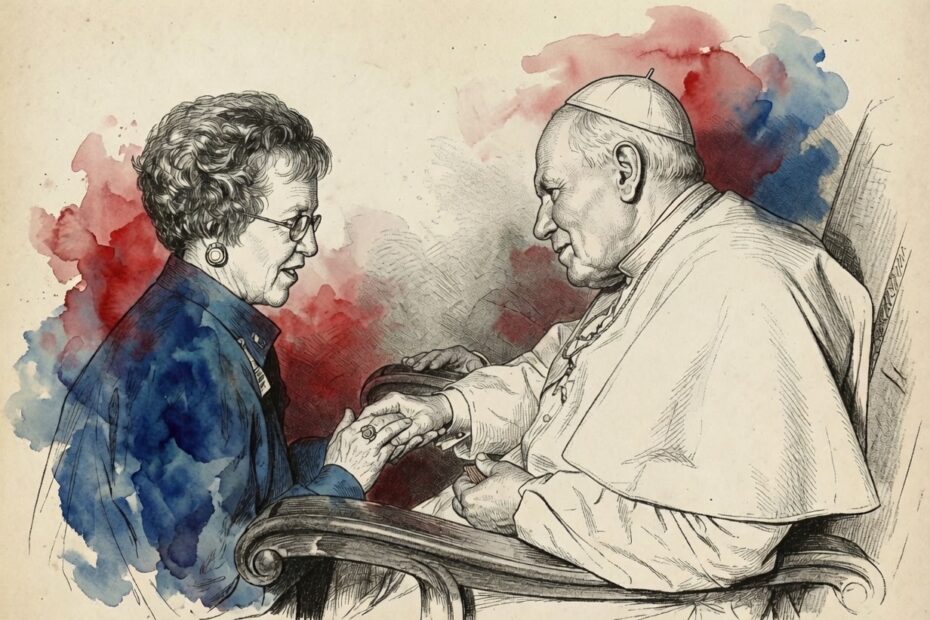
Saint John Paul II will forever be imprinted in my memory, not only because of the double hitter, as I like to call Veritatis Splendor (The Splendor of Truth) and Evangelium Vitae (The Gospel of Life), but because he was among the most gracious Catholic leaders my husband and I ever had the good fortune to meet. When one considers the innate goodness of a saint, one never expects to exchange words with him. So during our hours of reflection and preparation of ALL’s study guides for those two encyclicals, we never could have imagined having the privilege of presenting copies to him personally.
We traveled to the Vatican with the members of our staff who had worked with us diligently to prepare the manuscripts. At the time of our visit with the Holy Father, we were still working on the final versions, but we presented him with a blue notebook containing the final draft, and we were utterly speechless when he looked at us and said he wanted to bless each of us for our work.
I have many memories of that event, but the one thing that surpasses all of them was his glorious presence. We simply knew we were in the presence of a saint, even though he was standing before us and smiling at the people sitting with us in the Vatican’s Paul VI Audience Hall. In 1995, his holiness had the stamina to greet each person, to deliver words of encouragement to us who fight for life, and to welcome us to his city. But above all, he emanated love—the love of Christ for His Church, His family, and His mission of teaching.
Words will never adequately describe that day 31 years ago, but quotes from his inspiring writings will help us tempt you to read both encyclicals fully, absorb their meaning, and cherish the wonderful legacy Saint John Paul II left to people around the world.
So without further ado, here are just a few pearls of wisdom, beginning with The Splendor of Truth:
1. “It is always possible that man, as the result of coercion or other circumstances, can be hindered from doing certain good actions; but he can never be hindered from not doing certain actions, especially if he is prepared to die rather than to do evil.” (#52)
2. “Human acts are moral acts because they express and determine the goodness or evil of the individual who performs them. They do not produce a change merely in the state of affairs outside of man but, to the extent that they are deliberate choices, they give moral definition to the very person who performs them, determining his profound spiritual traits.”(#71)
3. “Faith is a decision involving one’s whole existence. It is an encounter, a dialogue, a communion of love and of life between the believer and Jesus Christ, the Way, and the Truth, and the Life (cf. Jn 14:6). It entails an act of trusting abandonment to Christ, which enables us to live as he lived (cf. Gal 2:20), in profound love of God and of our brothers and sisters.” (#88)
Quotes from The Gospel of Life:
1. Contraception and abortion “are rooted in a hedonistic mentality unwilling to accept responsibility in matters of sexuality, and they imply a self-centered concept of freedom, which regards procreation as an obstacle to personal fulfilment. The life which could result from a sexual encounter thus becomes an enemy to be avoided at all costs, and abortion becomes the only possible decisive response to failed contraception.” (#13)
2. Quoting Canon Law, the pope writes, “A person who actually procures an abortion incurs automatic (latae sententiae) excommunication”. The excommunication affects all those who commit this crime with knowledge of the penalty attached, and thus includes those accomplices without whose help the crime would not have been committed.” (#62)
3. “The gospel of life is to be celebrated above all in daily living, which should be filled with self-giving love for others. In this way, our lives will become a genuine and responsible acceptance of the gift of life and a heartfelt song of praise and gratitude to God who has given us this gift. This is already happening in the many different acts of selfless generosity, often humble and hidden, carried out by men and women, children and adults, the young and the old, the healthy and the sick.” (#86)
It is impossible to adequately share these two profound encyclical letters in a few snippets, but by providing a small taste of each, we hope your spiritual curiosity is challenged. Reading them in full is a delight.
The world owes a great debt to Saint John Paul II, and I personally am humbled by having spoken with him. May his soul and the souls of all the faithful departed rest in peace. Amen!