By Judie Brown
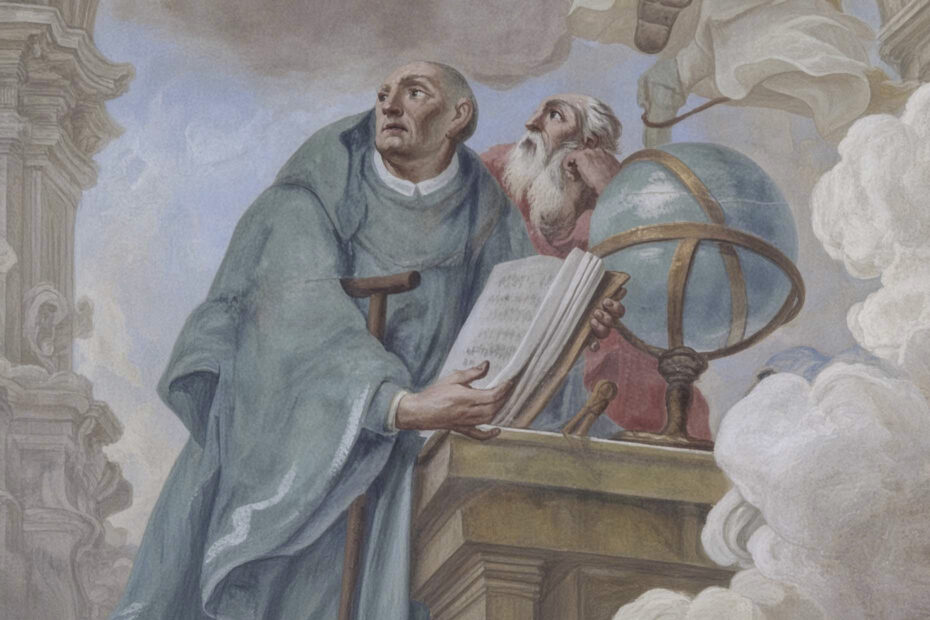
Anthony Esolen recently reminded me of Blessed Hermann the Cripple, who wrote “Salve Regina” and other glorious works. His story is a source of great inspiration for those of us striving to defend human dignity. According to a bio on EWTN,
Blessed Hermann von Reichenau (1013 – 1054), a native of Swabia, Germany, and the son of the Duke and Duchess of Altshausen, was born a cripple. It is believed he suffered from a cleft palate, cerebral palsy and spina bifida. At the age of seven, his parents entrusted him to the care of monks at a Benedictine Monastery situated on the shores of Lake Constance. He made his religious vows, becoming a Benedictine monk at the age of twenty.
Clearly Blessed Hermann was more overwhelmed with the power of God and His love for each person than he was with being fixated on his limitations, as “his monastery became a center of learning because of his contributions, and his writings on astronomy and the calendar were widely respected in medieval Europe.” Blessed Hermann’s zeal for the Lord was so overwhelming that any disabilities he might have had paled in comparison to his love of God.
We chose to focus on this amazing individual because of the growing passion in America to affirm the misanthropic behaviors of those who have chosen to defy God’s will in their quest to be people of political and social power. Understanding this lust for defiance of Truth, one commentator opined in “‘Queer Theology’ Has No Place in the Church,”
In the confusion of the self-soothed conscience, whatever the conscience has been assuaged about is now identified with the good and the holy. Christ’s gracious love for the sinner thus slips into the conviction that He graciously loves the sin.
Then anyone who disagrees with this conviction is accused of worshipping a false god—making an idol of the traditional teaching on marriage and sexuality. Indeed, for a gay person having to bear such treatment, being actively gay and Christian appears to be an especial grace, granting a particular insight into God not given to others—actually exposing God for who He really is.
Such a redefinition of God leads the soul who espouses it to the gates of the netherworld rather than into the arms of Our Lord and Savior. We pray for such people, but we also understand that for many of them, their zealotry is based on the conscious rejection of God’s will in favor of their own perspective. They view their zealotry as so urgent as to be superior to everything, including the divine.
History has shown that such folks are headed for hell, but in the process they can deter and destroy souls unfamiliar with the wiles of the evil one.
The Catechism of the Catholic Church explains getting to hell in simple terms:
We cannot be united with God unless we freely choose to love him. But we cannot love God if we sin gravely against him, against our neighbor or against ourselves: “He who does not love remains in death. Anyone who hates his brother is a murderer, and you know that no murderer has eternal life abiding in him.” . . . To die in mortal sin without repenting and accepting God’s merciful love means remaining separated from him forever by our own free choice. This state of definitive self-exclusion from communion with God and the blessed is called “hell.”
It is because of this that we reflect on the courage of Blessed Hermann and so many others like him. While it may not be popular to point out the wages of sin, it is even more serious to accommodate sin rather than exposing and working against it, regardless of who may or may not concur.
Misguided fanatics who spread falsehoods abound in the social free fall that occurs when God’s laws are reduced to mere suggestions. We see this, we understand this, and we are called to stand up and proclaim the truth. This is so because we are crusaders for the Lord, striving to do all we can to bring souls back from the precipice and into the arms the God, who loves every person without exception, today, tomorrow, and always.
Being defenders of life requires relentless zeal.