By Judie Brown
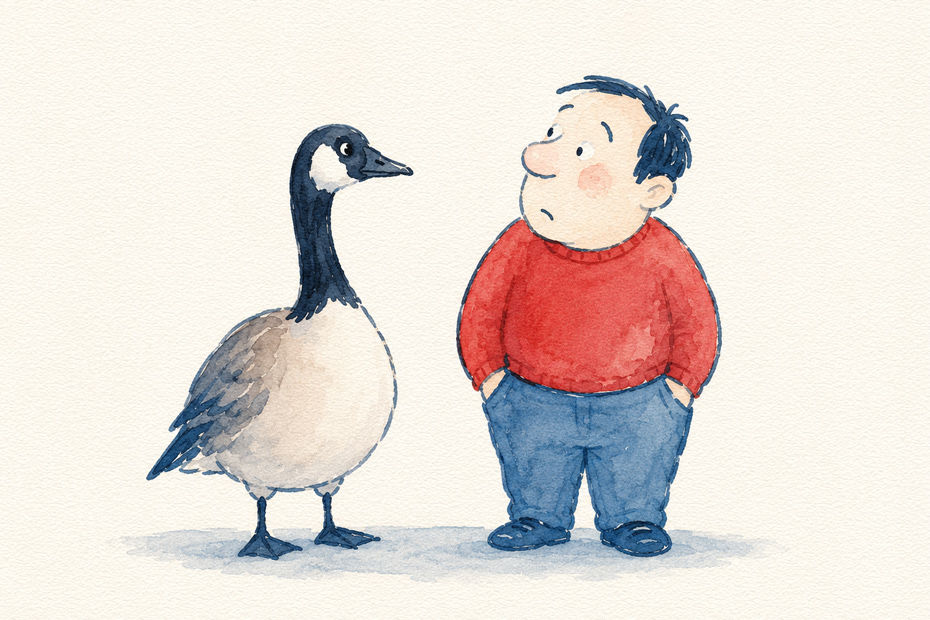
Recent headlines provoked me to ask a simple question: Why are Canadian geese more important than people? This came to mind when we learned about the Alabama community of Edgewater, where some residents were upset that homeowner association leadership wanted to euthanize migrating Canadian geese.
Juxtapose that with New York governor Kathy Hochul’s support for assisted suicide, and we might wonder just what makes some people prioritize migrating wildlife and some impose death on the unwanted people in their midst.
Governor Hochul said that “New Yorkers deserve the choice to endure less suffering, not by shortening their lives, but by shortening their deaths—I firmly believe we made the right decision.”
This is a perfect example of higgledy-piggledy priorities. The contrast between such jumbled priorities underscores the mess our nation has created by patchwork laws that span the moral abyss between killing people and saving animals that are part of nature’s kingdom.
The governor is twisting morality to suit the death lobby while at the same time dismissing human suffering as though it were a plague on society.
Compare her advocacy of self-imposed death with these words from Saint John Paul II, who taught:
As a result of Christ’s salvific work, man exists on earth with the hope of eternal life and holiness. And even though the victory over sin and death achieved by Christ in his Cross and Resurrection does not abolish temporal suffering from human life, nor free from suffering the whole historical dimension of human existence, it nevertheless throws a new light upon this dimension and upon every suffering: the light of salvation. This is the light of the Gospel, that is, of the Good News. . . .
Those who share in Christ’s sufferings have before their eyes the Paschal Mystery of the Cross and Resurrection, in which Christ descends, in a first phase, to the ultimate limits of human weakness and impotence: indeed, he dies nailed to the Cross. But if at the same time in this weakness there is accomplished his lifting up, confirmed by the power of the Resurrection, then this means that the weaknesses of all human sufferings are capable of being infused with the same power of God manifested in Christ’s Cross. In such a concept, to suffer means to become particularly susceptible, particularly open to the working of the salvific powers of God, offered to humanity in Christ.
These words underscore the value and meaning of human suffering. Though we may at times find it challenging to comprehend this, particularly when someone we care about is suffering, we strive to realize that by joining our experiences with pain and dying with the sufferings of Christ, we see the opportunity to be truly one with Him, even and perhaps especially during our final moments on this earth.
Contrast this undeniable truth with what Hochul opines and we see a crisis in human attitudes that is akin to treating our fellow human beings in exactly the same way some Alabama residents treat Canadian geese, all of which were euthanized.
Governor Hochul, who claims to be Catholic, wrote, “I was taught that God is merciful and compassionate, and so must we be. . . . This includes permitting a merciful option to those facing the unimaginable and searching for comfort in their final months in this life.”
“Merciful options” kill people, and as we have repeatedly said, human persons are created by God in His image, and they deserve our total affirmation at every stage of their lives. While people like Hochul would suggest that even sufferers of mental illness deserve imposed death, we proclaim that Christ walks with us and is ever with us, even in moments of excruciating agony.
The only priority worthy of man is to respect human persons, even in moments of pain, sorrow, and loss.