By Susan Ciancio
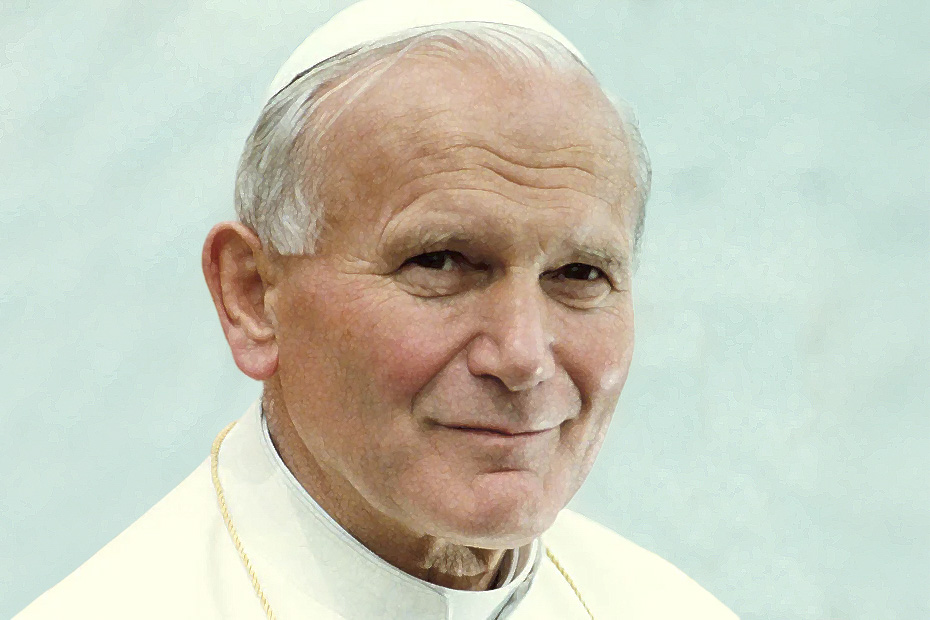
It’s fitting that we celebrate St. John Paul II’s feast day on October 22, during Respect Life Month. If you’ve ever read any of his encyclicals, homilies, letters, or any other works, you can clearly see through his beautiful writing that he genuinely loves all people and wants them to grow in faith. But more than that, his words inspire us think, and they motivate us to focus on what’s truly important in life—living according to Church teaching so that we can spend eternal life with God in heaven.
In Evangelium Vitae, the Holy Father wrote, “We are facing an enormous and dramatic clash between good and evil, death and life, the ‘culture of death’ and the ‘culture of life.’ We find ourselves not only ‘faced with’ but necessarily ‘in the midst of’ this conflict: We are all involved and we all share in it, with the inescapable responsibility of choosing to be unconditionally pro-life.”
Unconditionally pro-life. What does that mean? It means that we cherish and respect all people from creation until death, certainly never taking any action that will end a life prematurely, but also taking action to serve the vulnerable, the forgotten, and the poor with charity and kindness. It is not always easy, but it’s what our faith commands of us.
To encourage you along this journey, we want to highlight eight of St. John Paul II’s quotes that inspire us to continually fight not only for preborn babies but for people at every moment of their lives. After each quote, you will find a short reflection that we hope you can ponder and share with your family and friends.
- “All human life—from the moment of conception and through all subsequent stages—is sacred, because human life is created in the image and likeness of God.” – 1979 Mass
In the book of Genesis, we read that God created man and woman in His image. We are all His beloved children with inherent dignity. Abortion, euthanasia, and other threats to human life ignore this truth and attempt to turn people into a commodity, teaching that they are only here to serve a purpose and only if they are wanted. St. John Paul’s words remind us that, because God created us in His image, we are all wanted and loved regardless of our abilities or stage in life.
- “Respect, protect, love and serve life, every human life! Only in this direction will you find justice, development, true freedom, peace and happiness!” –Evangelium Vitae
This is a challenge for every single one of us, and it’s one we cannot take lightly. As we learned in the Parable of the Talents, we must not bury our gifts but use them for the good of others. How we answer that challenge is different for everyone because we have all been gifted with different talents and abilities, but if we truly want peace, we cannot sit back and tolerate the war against the vulnerable. We must take action by speaking, serving, and/or protecting those around us, especially those in need.
- “Human life is sacred and inviolable at every moment of existence.” –Evangelium Vitae
A baby just created is just as valuable as a newborn, as a toddler, as a teenager, and as an adult. Though this is an unpopular truth, it’s a truth nonetheless. It is our responsibility to teach this to our family and our friends most certainly, but also to those whose hearts are hardened to this truth. We all know someone who balks at this. We invite you to pray today to discern ways you can soften their hearts.
- “The embryo is a human individual and, as such, possesses the inviolable rights of the human being.” – 2003 Address
An embryo is simply a stage of development in a human being’s life. That stage doesn’t make him any less human. This is why we must oppose threats to embryos, such as IVF and of course abortion. Both result in dead babies.
- “We must continue to pray and dedicate ourselves to ensuring that the culture of life will prevail over that of death.” – 1998 Angelus
Pray unceasingly but act to protect life and to teach your kids the value of all human beings. Actions are necessary if we want to change our culture. To do this, we must speak up for the vulnerable, visit the sick and lonely, volunteer our time at shelters or pregnancy help centers, and give material goods to those who need them. Only when we live the values that we believe will we change hearts and minds.
- “America, defend life so that you may live in peace and harmony.” – 1993 Address
This charge by St. John Paul II is not always an easy one. It requires work and effort on our part, but it also includes standing up for a country that was founded on Christian principles. That means we have to leave the comfort of our home and vote for the candidates who do not pose threats to life and who do not endorse a culture of death. We can make a difference in our own communities, but we need to elect politicians who respect the sanctity of life so that our wider communities, states, and nation can come to see the beauty of all people.
- “To defend the right to life of unborn children is one of the greatest human rights issues of our day.” – 1993 Address
Over 64 million babies have been killed by abortion in the US since Roe v. Wade was decided in 1973. Worldwide, the number is even more staggering. The World Health Organization states that over 73 million abortions occur each year. This tragedy should break the hearts of every single person, yet many cheer for—and vote for—the widening of these threats and increasingly liberal laws regarding killing a preborn baby. Especially now, as we face midterm elections, it’s time to acknowledge the fact that abortion is one of the greatest human rights issues today and take whatever peaceful actions we are capable of as we fight for the sanctity of life.
- “The family is the heart of the culture of life.” – 1994 letter
If we want to change our world, we must begin at home. Husbands, love your wives. Wives, love your husbands. Parents, nurture your children and teach them the faith. Give them the courage they need to stand up for the vulnerable. Give them the intellectual tools they need to teach others about the sanctity of life. We must protect not only our own families but the idea of family, as it truly is the foundation of society.