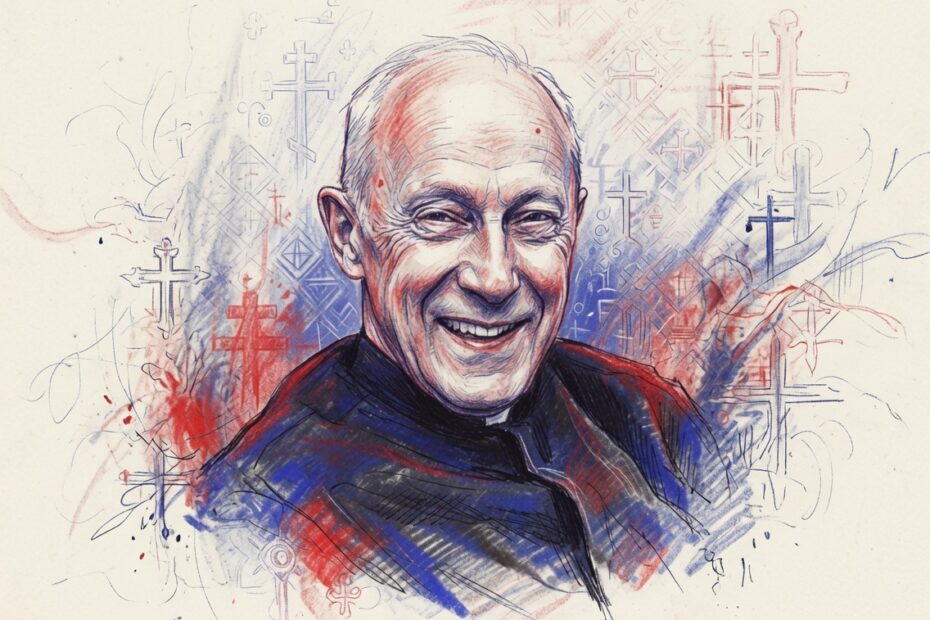
By Judie Brown
To have known Father John Hardon, SJ, is to have been in the company of one of the most holy men I have ever encountered. Father Hardon was a teacher, a preacher of extraordinary power, and a man committed to making sure Catholics understood the teachings of the Church he loved so much.
His written works include a Catechism on the Real Presence, a booklet that he prepared based on the 1965 papal encyclical Mysterium Fidei (The Mystery of Faith). Written by Pope Paul VI, the encyclical invites us to a deeper appreciation of the Eucharist. The pope wrote this letter to all people of faith during a time when there was much upheaval in the Church, not unlike what is currently taking place.
In paragraph 15 the pope wrote, “We want to recall something that you know very well but that is absolutely necessary if the virus of every kind of rationalism is to be repelled; it is something that many illustrious martyrs have witnessed to with their blood, something that celebrated fathers and Doctors of the Church have constantly professed and taught. We mean the fact that the Eucharist is a very great mystery—in fact, properly speaking and in the words of the Sacred Liturgy, the mystery of faith.”
This truth is, as Saint John Paul II was later to underscore, the Eucharist is the source and summit of our lives here on earth. He taught that the Eucharist is a source of holiness, a “divine gift [that is] the source of every other gift,” and of course the reason why we evangelize. John Paul continued, “Its goal is the communion of mankind with Christ and in him with the Father and the Holy Spirit.”
It is with sincere gratitude to Father Hardon that we quote from his Catechism on the Real Presence:
What does it mean to say that Christ is really present in the Eucharist?
It means that everything which makes Christ is present in the Holy Eucharist. At the Council of Trent it was defined that the whole Christ is contained in what had been bread and wine but is now only the physical properties of bread and wine. The substance of bread and wine becomes Jesus Christ in the fullness of His divinity and humanity.
Father Hardon tells us that, while receiving the Blessed Sacrament, the multitude of believing Christians are united among themselves by sharing in the same flesh and blood of the Eucharistic Lord.
While it would be simple to continue quoting Father Hardon’s catechism, the truth is that for each one of us who knows the truth about the Eucharist, so much more can be gleaned by holding that catechism in your hands and studying it, word for word, question after question.
I choose to share this with you because it is my sincere belief that among America’s Catholics there is a bond that should compel them to spread the word, teach this truth, and witness to the glory of the Blessed Sacrament.
But as Pew Research found, “Weekly Mass attendance for Catholics . . . was only 29%.”
It is a profound source of sadness to those of us who love our faith to learn how easy it is to say that someone is Catholic, but how challenging it is to be a practicing Catholic. Given this reality in our nation today, it seems to me that we pro-life people have our work cut out for us.
After all, if the Real Presence of Christ in the Eucharist is a mere afterthought for so many, how can we hope to educate them about the real presence of the baby before birth?
As Father Hardon writes in the Catechism on the Real Presence, the most important means for uniting Christians is to restore faith in the Real Presence of Jesus Christ in the Eucharist.
Let us strive every day to witness to the transubstantiation that takes place on the altar during every Mass, while praying for those who see but do not believe.