By Judie Brown
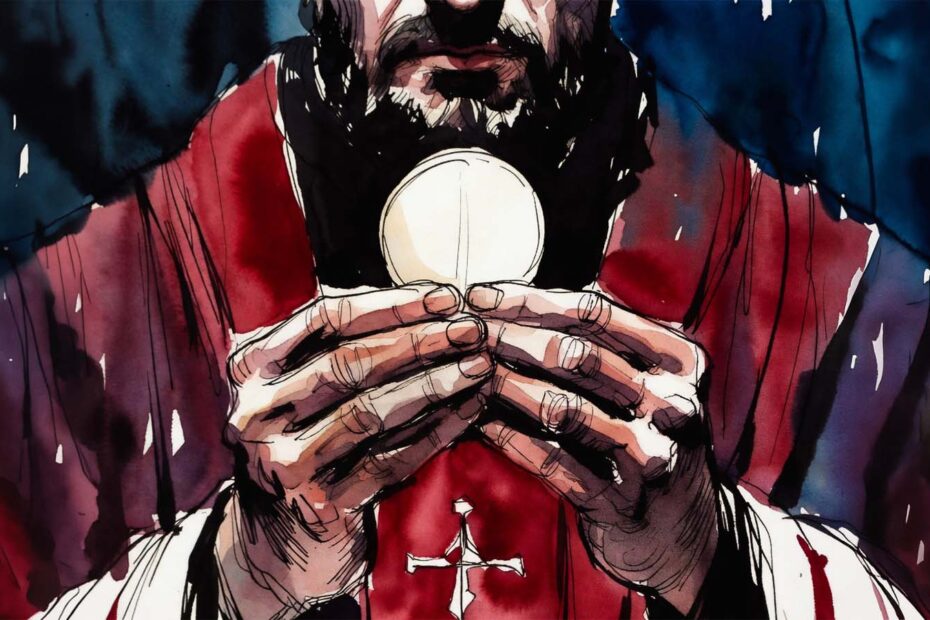
On June 7, Catholics will reverence the Solemnity of the Body and Blood of Christ. Perhaps in anticipation of this feast, Pope Leo XIV wrote in Magnifica Humanitas:
In the Eucharist we find a visible manifestation of the reality that we “are the Church of Christ, his members, his body. We are brothers and sisters in him. And in Christ, though many and diverse, we are one: In Illo uno unum.” The Eucharist opens us to justice and sharing, with a preferential concern for those who are burdened by poverty or marginalization. And while new economic and technological networks can generate exclusion, isolation and dependencies, the Church—nourished by the Eucharist—is called to make visible a different paradigm, one that preserves human connections, gives a voice to the invisible and ensures that processes are aimed at respecting people’s dignity.
What better way to celebrate the miracle of the Eucharist than to remember that humbling ourselves before Christ ensures our desire to serve the most vulnerable. As Father Mike Schmitz reminds us, the Eucharist “is both a noun and a verb,” with the verb being “the offering of the sacrifice.”
This heavenly food is a necessity for us Catholics, particularly during the troubled times in which we live. For one writer, this is more than obvious. He writes:
Modern culture excels at production but suffers from amnesia. We forget not only doctrine but wonder itself. The Eucharist confronts this forgetfulness by commanding remembrance: “Do this in memory of me.” To remember in the biblical sense is not mental recall but participation—entering again into the saving event. Each Mass gathers the centuries into a single hour; Calvary is not repeated but made present.
Such reminders drive us to contemplate our personal relationship with Christ, not only in the Eucharist but in our daily lives. The wonder of Christ made present to each of us as we receive His body is a moment to be cowed into humility, as we proclaim, “Lord, I am not worthy to have You enter under my roof; only say the word and my servant will be healed.”
Like the Centurian, we are stained with sin, yet our hope resides in the love and mercy of the Lord, who beckons us individually to come and receive Him and be healed through our desire to make all things new. For most of us, that is a daily, if not an hourly, struggle, but Christ is always patient. He knows us better than we could ever know ourselves.
As we prepare to receive Him, we pray for all those who defy His mercy and continue to involve themselves in manifest grave sin, not with remorse for past offenses but with impunity, thinking that they are worthy to receive Him. Such individuals who publicly advocate for evil remind us of the words of Saint John Vianney, “The demon is very cunning, but he is not strong. Making the sign of the cross soon puts him to flight.”
Recognizing that demon requires a well-formed conscience, not to mention a sincere desire to repent. The devil is, after all, the mastermind of everything that denies the human dignity of which Pope Leo wrote.
And so, as we approach this sacred solemnity, not to mention every day of our lives, we are grateful for the wisdom contained in these words:
To receive the Body and Blood of Christ in Holy Communion is to receive Love incarnate. To receive the Body and Blood of Christ in Holy Communion is to receive the body of teachings that Christ has passed down to His Church—teachings that challenge us to be counter-cultural, teachings that nourish us in the struggle to be faithful Catholics in an age where every idea is tolerated except the idea that holds to an objective truth that is unchangeable, even when it might not match up with the fleeting trends of the day. To receive Christ in Holy Communion is to receive the commission to do as Christ did, to speak as Christ spoke, to be as Christ was and is.