By Judie Brown
Archbishop Fulton J. Sheen once wrote, “It is part of the discipline of God to make His loved ones perfect through trial and suffering. Only by carrying the cross can one reach the Resurrection.”
This simple statement has become the stumbling block for many people who seek the joy of the Resurrected Christ without the agony that preceded it. We know that this is true simply by witnessing the way the world views Holy Week and all its significance for those who choose to walk with Christ to the cross and beyond.
In one of his most inspiring homilies, Saint John Paul II said:
“The Son of Man must be lifted up,” says Jesus to Nicodemus. And he says this with a view to his crucifixion: The Son of Man must be lifted up on the Cross. Whoever believes in him, whoever sees in this Cross and in the Crucified One the Redeemer of the world, whoever looks with faith on the redemptive death of Jesus on the Cross, finds in him the power of eternal life. By this power, sin is overcome. People receive forgiveness of their sins at the price of the Sacrifice of Christ. They find again the life of God which had been lost by sin.
This is the meaning of the Cross of Christ. This is its power. “God sent his Son into the world not to condemn the world, but so that through him the world might be saved.”
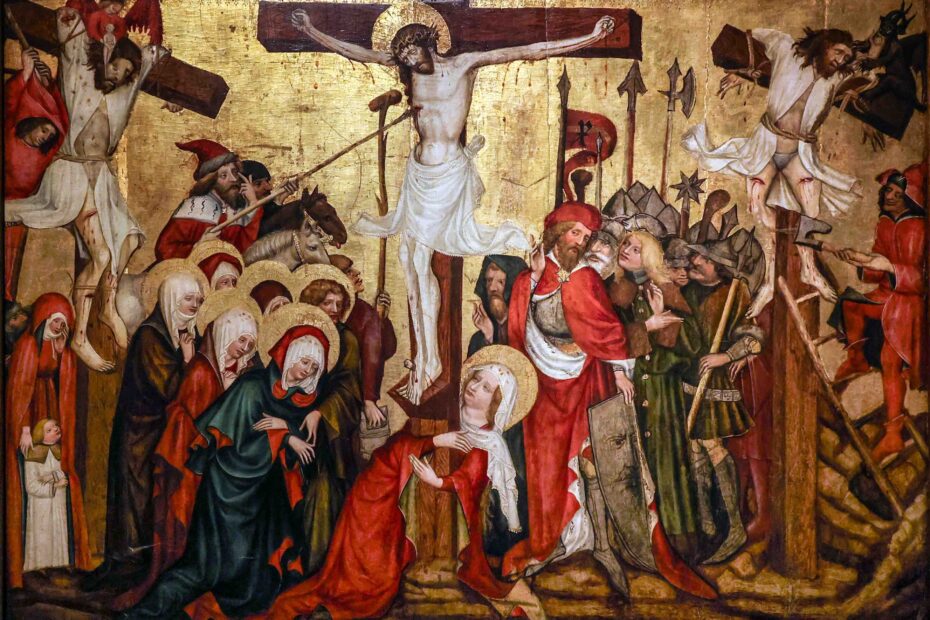
As we prepare for Good Friday, we meditate on this very truth: Without the cross, there can be no Resurrection.
Father Samuel Keyes explains:
The cross is the sign of new creation, but it also is the new creation, because it is a sign and a symbol of death—of the most horrible and painful and dehumanizing death—that has been seized by God and forged into a means—not just a symbol, but an actual means—of life. Whatever shape the cross takes—with or without the crucified body, in plain wood, or stone, or brass or gold encrusted with jewels—in physical gesture, there can be no getting behind it, no uncovering its true meaning, because the cross is always already its own true meaning. It is always already something that it is not: both death and life. Though the cross has, as G.K. Chesterton put it, “at its heart a collision and a contradiction, [it] can extend its four arms for ever without altering its shape. Because it has a paradox in its center, it can grow without changing.”
So it is that with Christ as victim and redeemer, we can look upon the crucifix with sorrow, gratitude, and celebration. As we consider the fact that God’s Son loved us so much that He endured unimaginable suffering, we can say “Thank You, Jesus. I love You, Lord Jesus.”
Such unimaginable anguish prompted Saint Paul in Galatians 6:14 to write, “But as for me, it is out of the question that I should boast at all, except of the cross of our Lord Jesus Christ, through whom the world has been crucified to me, and I to the world.”
Pondering the Crucifixion helps us in our own suffering and in that of those we love. For me, this holds a very special meaning as I consider the severity of the pain my husband endured before his death. Without Christ, without faith, and without that very suffering, the joy of the Resurrection would be empty.
Thank You, Jesus, for reminding us of this every day of our lives, especially when we make the Sign of the Cross.